Best Portable Jump Starter
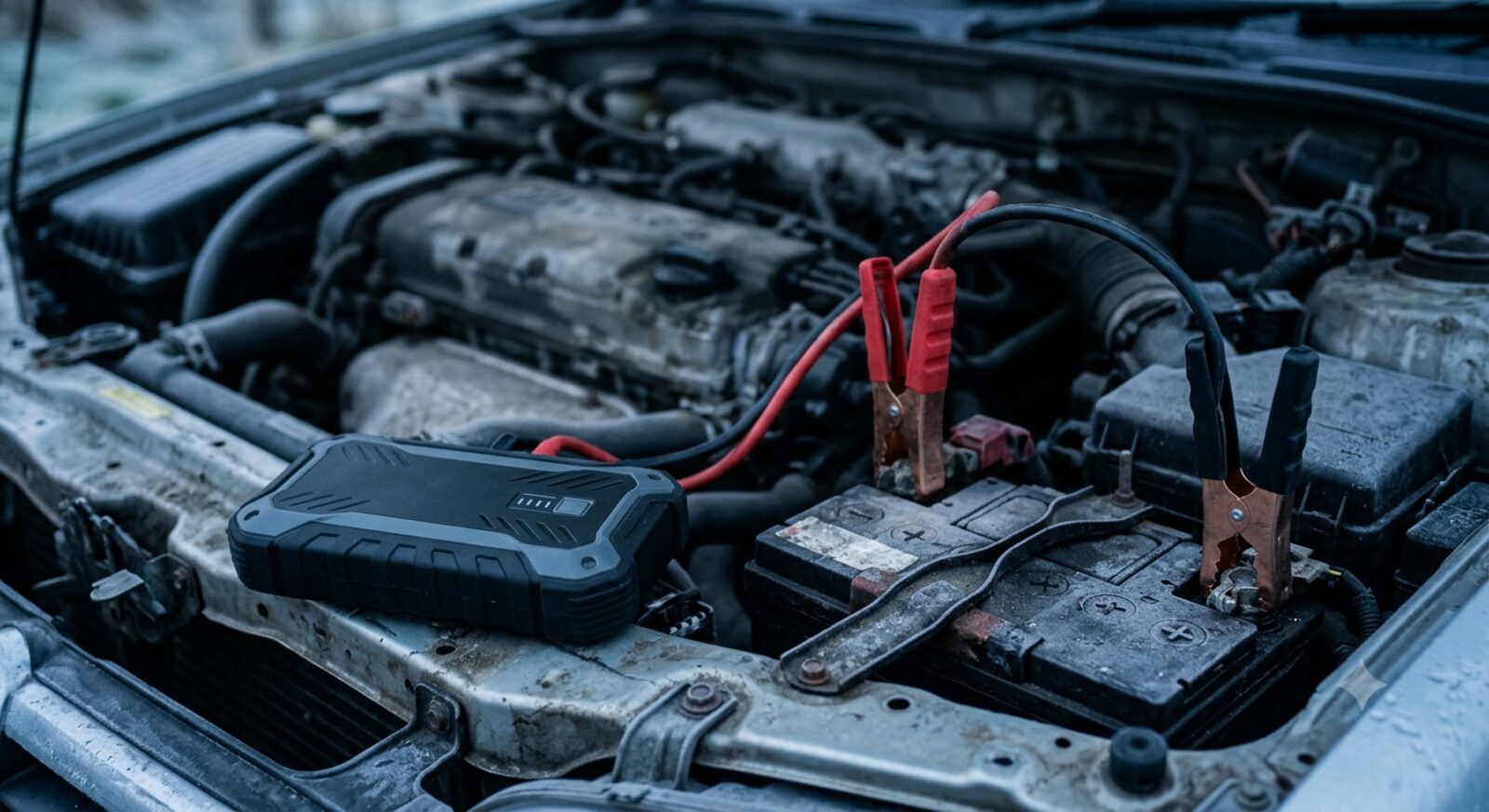
Buy on disclosed capacity and chemistry, and a disclosed cranking-amps figure where available — not the undefined "peak amps" headline. Weego and Schumacher are the rare brands here that publish a cranking-amps number alongside their peak-amp claim. autowit's SuperCap 2 is the odd one out: a supercapacitor unit built for extreme temperatures rather than peak numbers.
The one thing to know: "Peak amps" has no governing test standard. No independent body defines the temperature, the load, or the duration behind the number — manufacturers set their own test conditions, or disclose none at all. A $30 unit and a $150 unit can both claim "3000 peak amps," and neither figure is directly comparable to the other or auditable by a third party.
Price bands, not exact prices
We don't publish exact prices (Amazon prices change constantly and are always current on the live listing). As a rough band at the time of writing: compact peak-amp units (NOCO GB40, autowit SuperCap 2) tend to sit in the budget band; mid-capacity all-rounders (GOOLOO GP4000, Avapow A28, DBPOWER G16, Antigravity XP-10) tend to sit in the mid band; and larger-capacity, higher-Wh units built for bigger engines (HULKMAN Alpha85, Weego 66) tend to sit in the premium band. Check the live listing for the current price.
Our picks — by disclosed spec, not marketing
Research-based picks (how we evaluate), from manufacturer specification sheets and public retailer listings, not hands-on lab tests. Live Amazon search links, no product prices or ratings, an honest drawback on each.
NOCO Boost Plus GB40
1,000A advertised peak, 2,150mAh/24Wh LiFePO4, rated for 6.0L gas / 3.0L diesel
Uses LiFePO4 (lithium iron phosphate) cells, the most thermally stable lithium chemistry in this category, and NOCO discloses the pack's Wh rating plainly.
Best for: Buyers who want a well-documented small-engine unit from a brand that publishes real Wh figures
Watch out: No disclosed cranking-amps (CA/CCA) figure — only the undefined 'peak amps' number is marketed, and our own capacity-based plausibility check flags the 1,000A claim as implausible as a sustained current for this cell size (see the Cranking Amp Reality Index).
Check price on AmazonNot deciding today? Add it to your cart over there — Amazon keeps it saved (and flags any price change) until you're ready.
HULKMAN Alpha85
2,000A advertised peak, 20,000mAh/74Wh lithium-ion, rated for 8.5L gas / 6.0L diesel
Large 74Wh pack gives genuinely high total energy storage and a claimed ~60 jump starts per charge.
Best for: Larger gas engines and buyers who want more charge cycles between recharges
Watch out: Marketing labels the 2,000A figure 'peak cranking amp,' blurring peak-amp and cranking-amp language even though no SAE J537 CCA figure is disclosed — read our Peak Amps vs CA vs CCA vs MCA decoder before assuming this is a cranking-amp rating.
Check price on AmazonNot deciding today? Add it to your cart over there — Amazon keeps it saved (and flags any price change) until you're ready.
Weego 66 (N66)
2,500A advertised peak, 600 CA disclosed, 66Wh lithium-ion, rated for 10L+ gas / 5L+ diesel
One of the few jump starters in this category that discloses a separate cranking-amps (CA) figure alongside the peak-amp headline number, instead of marketing peak amps alone.
Best for: Buyers who want at least a partial sustained-current figure to compare against the CCA table
Watch out: The disclosed '600 CA' is not stated as an SAE J537-tested CCA figure — it appears to be a manufacturer cranking-amp claim, not an independently certified cold-cranking-amps rating, so it should still be read as a brand claim rather than a lab-audited standard.
Check price on AmazonNot deciding today? Add it to your cart over there — Amazon keeps it saved (and flags any price change) until you're ready.
GOOLOO GP4000
4,000A advertised peak, 24,000mAh lithium-ion, rated up to 10.0L gas / 10.0L diesel
The highest advertised peak-amp figure in our dataset, paired with a large 24Ah battery for many jump-start cycles per charge.
Best for: Buyers drawn to the biggest peak-amp headline number who want to understand what it actually means before buying on that number alone
Watch out: No disclosed cranking-amps (CA/CCA) figure. Our capacity-based plausibility check flags the 4,000A claim as physically implausible even as a brief pulse relative to the pack's stated capacity — see the Cranking Amp Reality Index for the calculation and its assumptions.
Check price on AmazonNot deciding today? Add it to your cart over there — Amazon keeps it saved (and flags any price change) until you're ready.
Schumacher SL1397
1,000A advertised peak, 500 CA disclosed, lithium-ion, battery capacity not disclosed
A mainstream hardware-store brand that discloses a specific cranking-amps figure (500 CA) on the packaging, not just a peak-amp headline.
Best for: Buyers who want a widely available big-box unit with at least a partial disclosed cranking spec
Watch out: Battery capacity (mAh/Wh) is not disclosed in the manufacturer's published specs we could find, which is itself the kind of gap our dataset flags as 'not disclosed' rather than guessing a number.
Check price on AmazonNot deciding today? Add it to your cart over there — Amazon keeps it saved (and flags any price change) until you're ready.
Antigravity XP-10 Gen 2
3,000A advertised peak, 600A disclosed starting current, 16,000mAh lithium-ion, rated up to 7.3L diesel
Discloses a separate '600A starting current' figure distinct from its 3,000A peak claim, giving buyers two numbers to compare rather than one undefined headline.
Best for: Diesel truck and towing owners wanting a compact unit with more than one disclosed current figure
Watch out: The '600A starting current' is a manufacturer term, not a named CA/CCA/MCA standard, so it cannot be directly compared to another brand's SAE-style rating without knowing its test conditions.
Check price on AmazonNot deciding today? Add it to your cart over there — Amazon keeps it saved (and flags any price change) until you're ready.
Avapow A28
3,000A advertised peak, 23,800mAh lithium-ion, rated for 8.0L gas / 8.0L diesel
A budget-tier unit with a large 23.8Ah pack and multiple marketed safety protections (reverse-polarity, over-current, over-temperature).
Best for: Budget buyers wanting a large-capacity pack for phone/device charging as well as jump-starting
Watch out: No disclosed cranking-amps (CA/CCA) figure. The plausibility check in our dataset flags the 3,000A claim as an extreme pulse-only figure relative to the pack's stated capacity — see the derived calculation before comparing it to a CCA-rated product.
Check price on AmazonNot deciding today? Add it to your cart over there — Amazon keeps it saved (and flags any price change) until you're ready.
autowit SuperCap 2
800A advertised peak, supercapacitor (no lithium cells, not rated in mAh), rated up to 8.0 gas / 4.0L diesel
Uses supercapacitors instead of a lithium battery — no cells to age or lose charge capacity over years, and it tolerates extreme temperature ranges (-40C to 70C) that degrade lithium packs.
Best for: Buyers in extreme climates or infrequent users who don't want a lithium pack self-discharging in storage
Watch out: Supercapacitors deliver their charge in seconds and cannot sustain output the way a battery can, so its lowest-in-category 800A peak claim is not directly comparable to lithium units — and it has no mAh/Wh capacity rating at all, since capacitors aren't specified that way.
Check price on AmazonNot deciding today? Add it to your cart over there — Amazon keeps it saved (and flags any price change) until you're ready.
DBPOWER G16
3,000A advertised peak, 80.66Wh lithium-ion, rated for 10.0L gas / 8.0L diesel
A compact, lightweight budget unit (under 1.5 lb) with a relatively large stated 80.66Wh capacity for its size.
Best for: Budget buyers wanting a lightweight glovebox unit for occasional use
Watch out: No disclosed cranking-amps (CA/CCA) figure. Our capacity-based plausibility check flags the 3,000A claim as physically implausible even as a brief pulse relative to the pack's stated 80.66Wh — see the Cranking Amp Reality Index.
Check price on AmazonNot deciding today? Add it to your cart over there — Amazon keeps it saved (and flags any price change) until you're ready.
Frequently Asked Questions
A disclosed cranking-amps (CA) or Cold Cranking Amps (CCA) figure, if available, plus the manufacturer's stated engine-size guidance for your vehicle's displacement and fuel type. The advertised peak-amp number should be treated as secondary marketing information, not the deciding spec.
Not necessarily on the specs we track. Price generally tracks battery capacity, build quality, and extra features (air compressors, displays, wireless charging) more than it tracks a disclosed cranking-amps figure, which remains rare across price tiers.
No. This is a research-based guide built from manufacturer specification sheets and public retailer listings, not hands-on lab testing. See How We Evaluate for our full methodology.