Jump Starters, Decoded by the Standard That Actually Exists
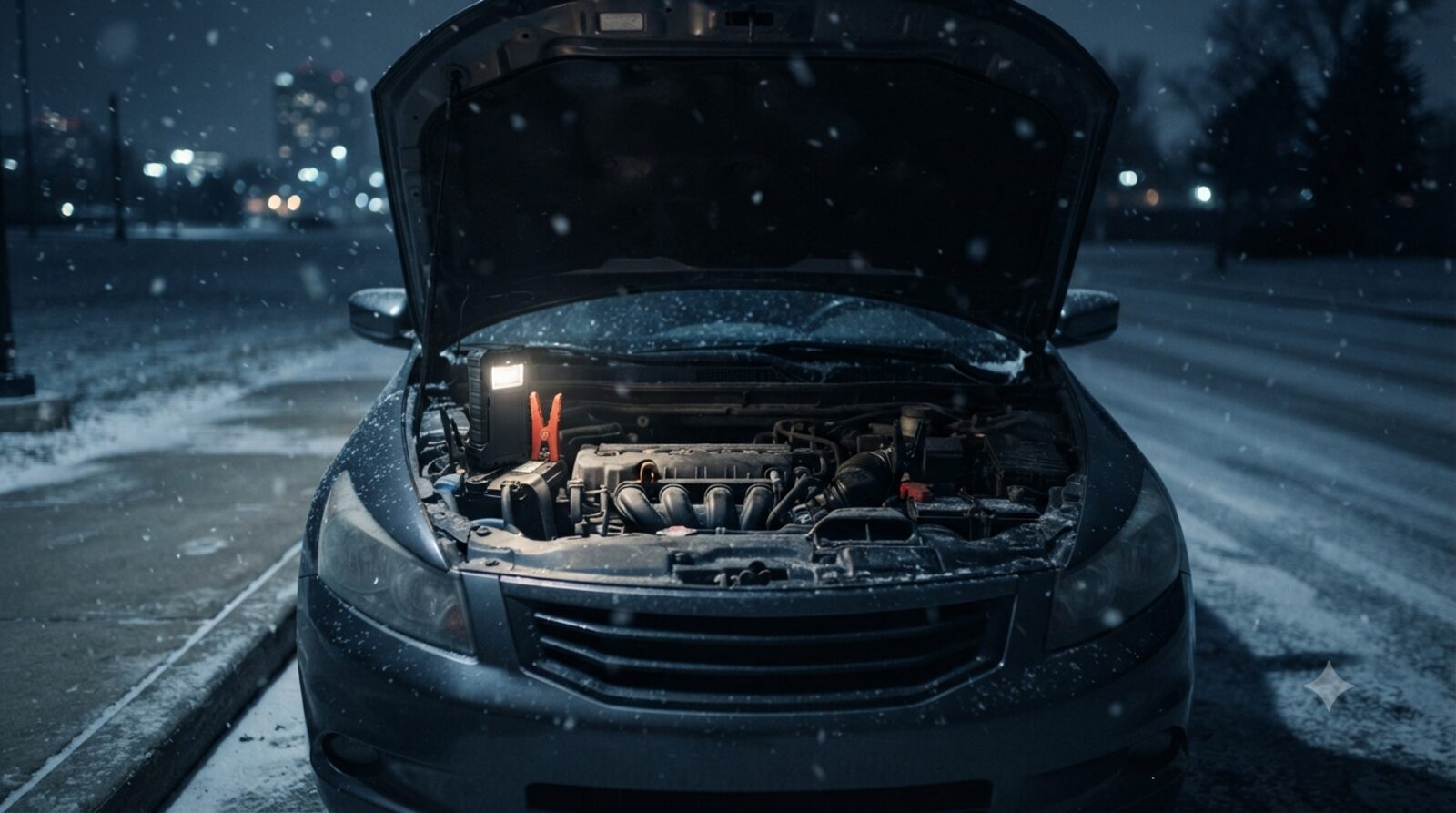
Every portable jump starter is marketed on "peak amps" — a figure with no governing test standard, no defined duration, and no defined load. The one number with a real engineering standard behind it is Cold Cranking Amps (CCA), defined by SAE J537 as the current a battery sustains for 30 seconds at 0°F without its terminal voltage dropping below 7.2V. Almost no jump starter discloses it. We built the Cranking Amp Reality Index to show, side by side, what's disclosed, what isn't, and whether an advertised peak-amp claim is even plausible given the battery behind it.
Search "best jump starter" and every result is published by a brand selling its own jump starters — Wolfbox, Hulkman, Weego — telling you their peak-amp number is the one that matters. We start somewhere else: the contaminant here isn't a chemical, it's an undefined marketing figure, and the closest thing to a neutral, third-party reference for how to actually read the spec sheet did not exist before this site.
Start here — four packs worth keeping in the car
Peak amps is a marketing figure measured for a fraction of a second. What starts an engine is sustained cranking current, and what matters six months later is whether the pack still holds a charge in a cold car. Each links to a live Amazon search rather than a fixed listing.
NOCO Boost Plus GB40
1,000A advertised peak, 2,150mAh/24Wh LiFePO4, rated for 6.0L gas / 3.0L diesel
Uses LiFePO4 (lithium iron phosphate) cells, the most thermally stable lithium chemistry in this category, and NOCO discloses the pack's Wh rating plainly.
Best for: Buyers who want a well-documented small-engine unit from a brand that publishes real Wh figures
Watch out: No disclosed cranking-amps (CA/CCA) figure — only the undefined 'peak amps' number is marketed, and our own capacity-based plausibility check flags the 1,000A claim as implausible as a sustained current for this cell size (see the Cranking Amp Reality Index).
Check price on AmazonNot deciding today? Add it to your cart over there — Amazon keeps it saved (and flags any price change) until you're ready.
HULKMAN Alpha85
2,000A advertised peak, 20,000mAh/74Wh lithium-ion, rated for 8.5L gas / 6.0L diesel
Large 74Wh pack gives genuinely high total energy storage and a claimed ~60 jump starts per charge.
Best for: Larger gas engines and buyers who want more charge cycles between recharges
Watch out: Marketing labels the 2,000A figure 'peak cranking amp,' blurring peak-amp and cranking-amp language even though no SAE J537 CCA figure is disclosed — read our Peak Amps vs CA vs CCA vs MCA decoder before assuming this is a cranking-amp rating.
Check price on AmazonNot deciding today? Add it to your cart over there — Amazon keeps it saved (and flags any price change) until you're ready.
Weego 66 (N66)
2,500A advertised peak, 600 CA disclosed, 66Wh lithium-ion, rated for 10L+ gas / 5L+ diesel
One of the few jump starters in this category that discloses a separate cranking-amps (CA) figure alongside the peak-amp headline number, instead of marketing peak amps alone.
Best for: Buyers who want at least a partial sustained-current figure to compare against the CCA table
Watch out: The disclosed '600 CA' is not stated as an SAE J537-tested CCA figure — it appears to be a manufacturer cranking-amp claim, not an independently certified cold-cranking-amps rating, so it should still be read as a brand claim rather than a lab-audited standard.
Check price on AmazonNot deciding today? Add it to your cart over there — Amazon keeps it saved (and flags any price change) until you're ready.
GOOLOO GP4000
4,000A advertised peak, 24,000mAh lithium-ion, rated up to 10.0L gas / 10.0L diesel
The highest advertised peak-amp figure in our dataset, paired with a large 24Ah battery for many jump-start cycles per charge.
Best for: Buyers drawn to the biggest peak-amp headline number who want to understand what it actually means before buying on that number alone
Watch out: No disclosed cranking-amps (CA/CCA) figure. Our capacity-based plausibility check flags the 4,000A claim as physically implausible even as a brief pulse relative to the pack's stated capacity — see the Cranking Amp Reality Index for the calculation and its assumptions.
Check price on AmazonNot deciding today? Add it to your cart over there — Amazon keeps it saved (and flags any price change) until you're ready.
Start with the two reference pages
The one thing to know: "Peak amps" has no governing test standard. No independent body defines the temperature, the load, or the duration behind the number — manufacturers set their own test conditions, or disclose none at all. A $30 unit and a $150 unit can both claim "3000 peak amps," and neither figure is directly comparable to the other or auditable by a third party.
How we work
We're a research-based reference site: we analyze manufacturer specification sheets, SAE and battery-industry standard definitions, and public retailer listings rather than physically testing units. We never claim a specific product's advertised figure is false — we present disclosed numbers side by side and let the absence of a governing standard for "peak amps" speak for itself. Read our full methodology →